A Day on Mars: Understanding Sols, Seasons, and Martian Time

Table of Contents — A Day on Mars: Understanding Sols, Seasons, and Martian Time
- What Makes Mars Time Different
- The Sol: A Martian Day
- The Martian Year
- Seasons on Mars
- Converting Earth Time to Mars Time
- Living on Mars Time
- Why This Matters for Future Colonists
- Common Questions
What Makes Mars Time Different
Mars looks a lot like Earth in some ways. It has days and nights. It has seasons. The sun rises and sets.
But the timing is different. A day on Mars is slightly longer. A year is nearly twice as long. Seasons stretch out over many months.
These differences matter. NASA mission controllers have worked on "Mars time" to coordinate with rovers. Future colonists will live by Martian clocks and calendars.
Understanding Martian time gives you a window into what life might look like on another planet — and how different it would feel from Earth.
The Sol: A Martian Day
On Mars, a day is called a "sol."
A sol is 24 hours, 39 minutes, and 35 seconds long — about 2.7% longer than an Earth day.
Why Is It Longer?
Mars rotates on its axis slightly slower than Earth. Both planets spin, but Mars takes a bit more time to complete one rotation.
The difference seems small — just 40 minutes. But it adds up.
The 40-Minute Drift
If you tried to keep Earth time on Mars, you'd quickly get out of sync.
Day 1: You're 40 minutes behind local Mars time. Day 10: You're nearly 7 hours behind. Day 30: You're 20 hours behind — you'd be sleeping when the sun is up.
This is why Mars missions use sols instead of days. It keeps human schedules aligned with Martian sunlight.
How Long Is a Sol Really?
- 1 sol = 24 hours, 39 minutes, 35 seconds (Earth time)
- 1 sol = 88,775 seconds
- 1 Earth day = 86,400 seconds
The ratio: 1 sol ≈ 1.027 Earth days
Or the other way: 1 Earth day ≈ 0.973 sols
The Martian Year
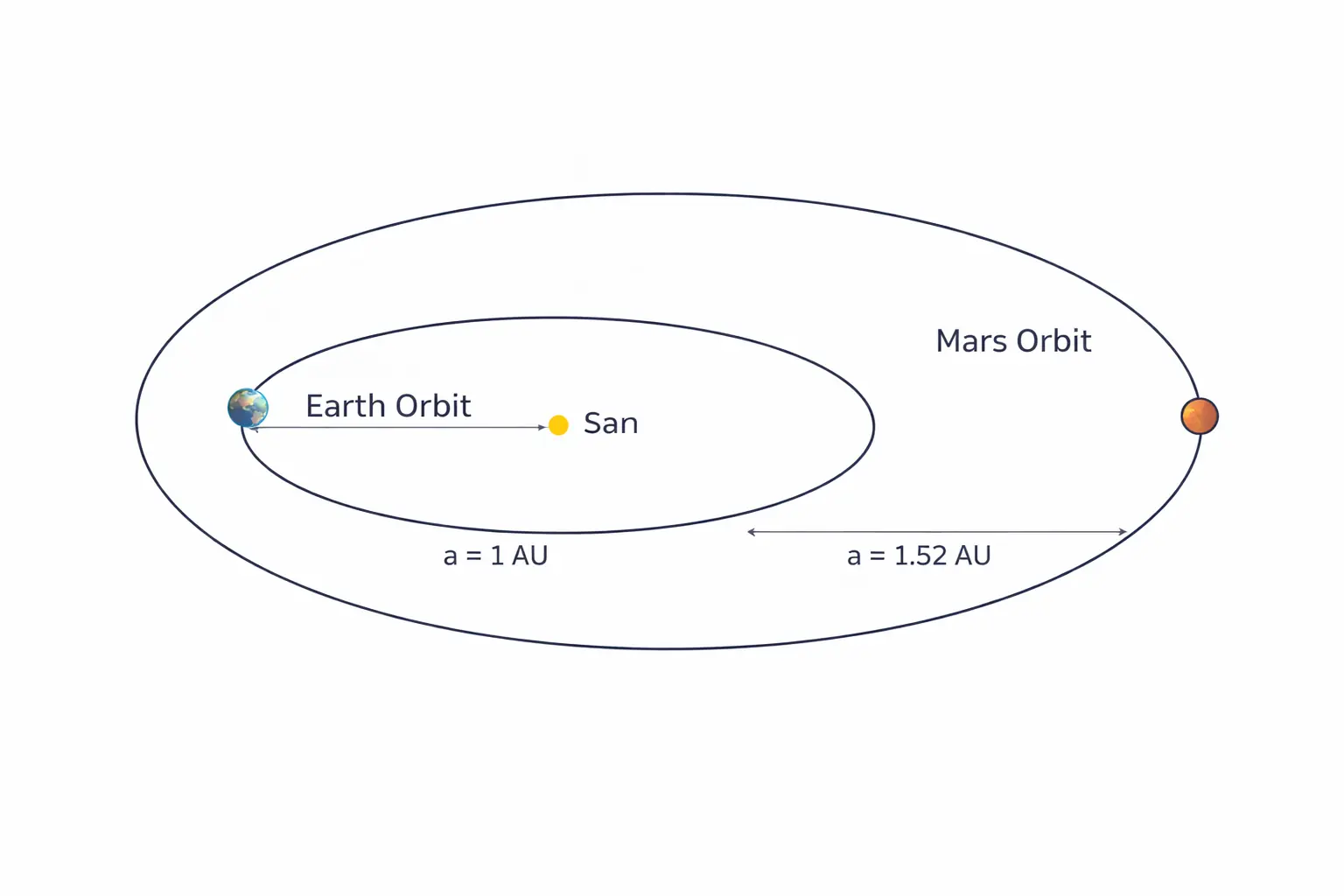
Mars takes 687 Earth days to orbit the Sun. That's about 1.88 Earth years per Mars year.
Why So Long?
Two reasons:
- Mars is farther from the Sun. It has a longer path to travel.
- Mars moves slower. The Sun's gravity is weaker at Mars's distance.
Both effects combine to make the Martian year nearly twice as long as Earth's.
How Many Sols in a Mars Year?
If a sol is 24 hours 40 minutes, and a Mars year is 687 Earth days, then:
687 ÷ 1.027 ≈ 668.6 sols per Mars year
So a Martian year has about 669 sols — compared to Earth's 365 days.
Birthday Math
If you're 30 Earth years old:
- 30 ÷ 1.88 ≈ 15.96 Mars years
On Mars, you'd be almost 16.
At age 60 on Earth, you'd be about 32 on Mars.
Try the Age on Mars Calculator to find your exact Martian age.
Seasons on Mars
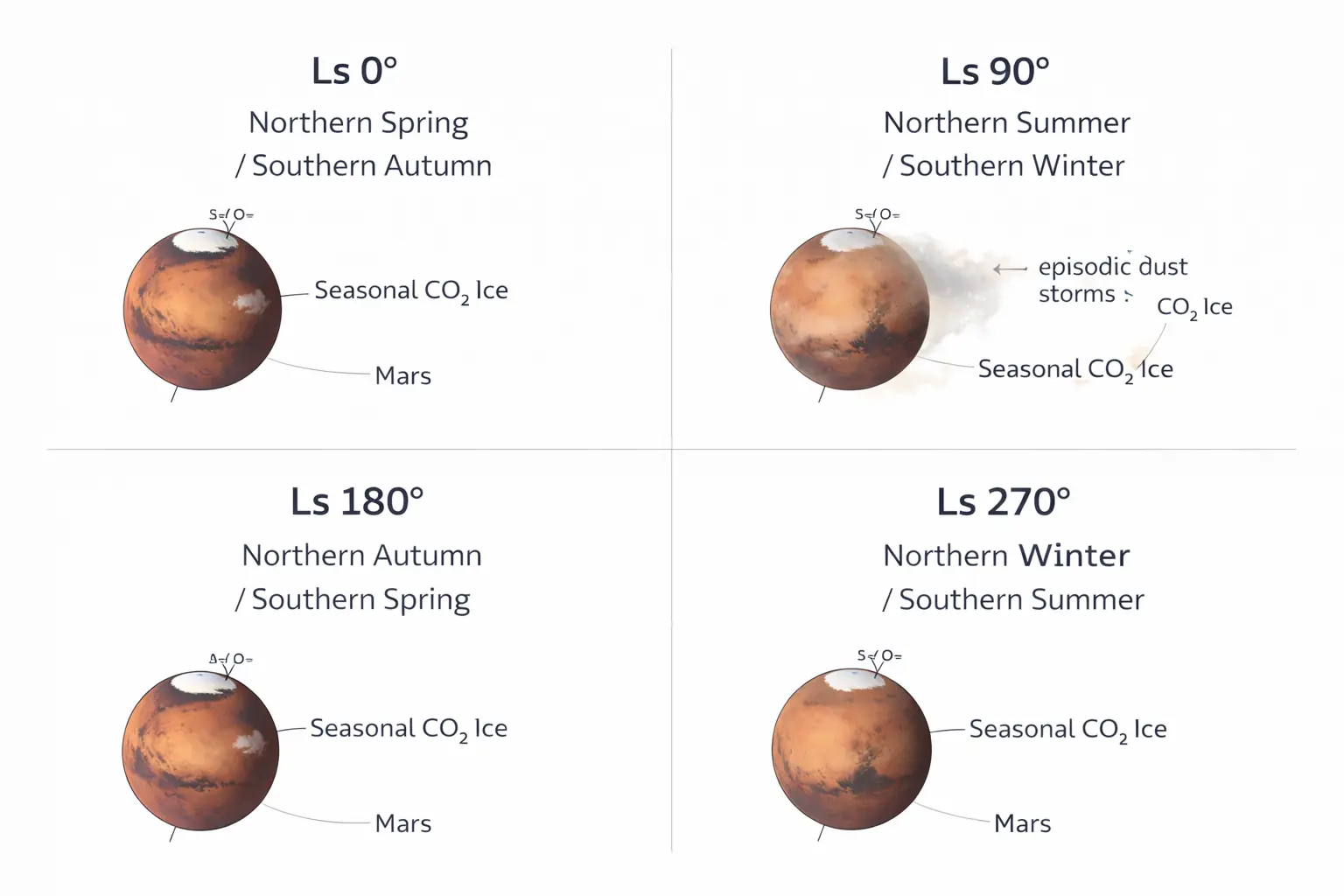
Mars has seasons, just like Earth. But they work differently.
Why Mars Has Seasons
Mars's axis is tilted at about 25 degrees — similar to Earth's 23.5-degree tilt. This tilt causes seasons. When the northern hemisphere tilts toward the Sun, it's northern summer.
So far, same as Earth.
Longer Seasons
Since a Mars year is 687 Earth days, each season lasts roughly twice as long as on Earth.
Earth summer: about 93 days Mars summer: about 178 days
That's nearly six months of summer in the northern hemisphere.
Unequal Seasons
Mars has an elliptical (oval-shaped) orbit. It's significantly closer to the Sun at some points than others.
This makes southern hemisphere seasons more extreme:
- Southern summer is shorter but hotter (Mars is closer to the Sun)
- Southern winter is longer and colder
Northern hemisphere seasons are milder and more even.
Dust Storm Season
Late southern spring through summer brings global dust storms. Mars gets so warm that dust gets kicked up and can envelope the entire planet for weeks.
This affects solar-powered missions. The 2018 global dust storm killed the Opportunity rover when dust blocked its solar panels.
Converting Earth Time to Mars Time
Here's how to convert between Earth and Mars time.
Sols to Earth Days
Earth days = Sols × 1.027
Example: A mission has lasted 100 sols. How many Earth days? 100 × 1.027 = 102.7 Earth days
Earth Days to Sols
Sols = Earth days ÷ 1.027
Example: You've been on Mars for 90 Earth days. How many sols? 90 ÷ 1.027 = 87.6 sols
Earth Years to Mars Years
Mars years = Earth years ÷ 1.88
Example: You're 36 Earth years old. 36 ÷ 1.88 = 19.1 Mars years
Mars Years to Earth Years
Earth years = Mars years × 1.88
Example: You've lived 10 Mars years. 10 × 1.88 = 18.8 Earth years
Use the Scientific Calculator for these conversions.
Living on Mars Time
What would daily life actually feel like with 24-hour-40-minute days?
The Drift Problem
If you kept your Earth habits, you'd drift out of sync with Mars.
Wake up at 7am on Sol 1. By Sol 18, your 7am is actually midnight Mars time.
You'd have to consciously adjust your schedule by 40 minutes every day, or just accept the drift.
How NASA Handles It
During active Mars rover missions, some NASA teams have worked on "Mars time."
This means:
- Shift start times by 40 minutes each day
- Sleep-wake cycles constantly drift relative to Earth
- Blackout curtains and careful light management
- Eventually cycling back around to normal Earth time
It's difficult. Most people struggle with constantly shifting schedules. Mission teams typically only do this for the critical early weeks of a mission.
What Colonists Might Do
Long-term Mars residents have options:
Option 1: True Mars time. Live by sols, accept that your schedule drifts relative to Earth contacts. Natural light matches your awake time.
Option 2: Earth time. Keep 24-hour days, accept that sometimes you're awake during Mars night and asleep during Mars day. Easier for communication with Earth.
Option 3: Hybrid. Use Earth time for work communications, Mars time for local activities.
There's no perfect answer. Future colonists will figure out what works best.
Light and Circadian Rhythms
Human bodies are built for roughly 24-hour cycles. The 24h 40m sol is close enough that people can adapt, but it's not automatic.
Light exposure timing, meal schedules, and activity patterns would all need attention. Indoor lighting in Mars habitats would need to mimic natural cycles to help residents adjust.
Why This Matters for Future Colonists
Understanding Martian time isn't just academic. If humans settle Mars, they'll need to solve real problems.
Calendar Systems
Earth's calendar is based on Earth's orbit. It won't work on Mars.
Proposed Mars calendars divide the 668.6-sol year into months. Common proposals use:
- 24 months of about 28 sols each
- Names borrowed from Earth months or created new
No official standard exists yet. Early colonies will probably invent their own.
Agriculture and Growing Seasons
If colonists grow food, they'll need to understand Mars seasons.
Longer seasons affect planting and harvesting schedules. The dust storm season affects light for greenhouses. Temperature cycles affect energy needs.
Energy Planning
Solar panels produce different amounts of energy depending on:
- Time of day (sol)
- Season
- Dust conditions
A Mars habitat needs to plan for long winters and dust storms that can block sunlight for weeks.
Communications with Earth
Mars-Earth distance varies as both planets orbit. At closest approach, messages take about 3 minutes one-way. At farthest, about 22 minutes.
When Mars is behind the Sun (solar conjunction), direct communication is impossible for about two weeks.
These communication windows must be planned around orbital mechanics, which depends on understanding both Earth and Mars years.
Common Questions
Why not just use Earth time on Mars?
You could, but you'd often be awake during Mars night and asleep during Mars day. This wastes daylight, complicates solar power use, and goes against natural human rhythms.
How did NASA pick "sol" as the name?
"Sol" comes from the Latin word for sun. It distinguishes Mars days from Earth days in mission communications.
Would my body adjust to a 24h 40m day?
Probably. Research suggests humans can adapt to slightly longer days. It wouldn't be instant, but most people would adjust over a few weeks.
What time zone would Mars use?
Probably local solar time for each settlement, like Earth. Different locations would have different "time zones" based on their longitude.
Coordinating between settlements would require a universal reference, perhaps based on a specific location like the first colony.
Are there "months" on Mars?
Not officially. Several proposed calendars exist, but none is standard. Early colonists will likely adopt or create a system.
How old would I be if I moved to Mars?
Your biological age stays the same. You'd just count birthdays differently. A 30-year-old moving to Mars would still be 30 Earth years, but would be "starting over" at around 16 Mars years.
Do Mars days and years affect gravity?
No. Gravity depends on the planet's mass and radius, not its rotation or orbit. Mars gravity is about 38% of Earth's regardless of time.
Check your Mars weight with the Space Weight Calculator.
The Big Picture
Time on Mars isn't that different from Earth — but different enough to matter.
Days: 40 minutes longer Years: 88% longer Seasons: Nearly twice as long
These differences seem small but create real challenges for missions and future settlements.
Understanding Martian time helps you appreciate what it would actually feel like to live on another planet. The familiar concepts of day, night, and year still exist — but with a twist.
If humans become a multi-planet species, we'll need calendars and clocks for each world. Mars is the first test case.
Related Articles
- Age on Mars Calculator — Your exact Mars age
- Planetary Years Explained — Orbital periods across the solar system
- Weight on Mars — How Mars gravity affects you
- Space Weight Calculator — Compare weights across planets
- Scientific Calculator — For time conversions