The Real Cost of Living in 2026: How to Measure What You Actually Pay

Table of Contents — The Real Cost of Living in 2026: How to Measure What You Actually Pay
- Why Official Inflation Numbers Don't Match Your Experience
- Your Personal Inflation Rate
- Breaking Down What You Actually Spend
- How to Calculate Your Real Purchasing Power
- What's Changing in 2026
- Practical Ways to Fight Rising Costs
- Planning for the Rest of the Year
- Common Questions
Why Official Inflation Numbers Don't Match Your Experience
The news says inflation is 4%. But your bills went up way more than that. What's going on?
Here's the thing: official inflation measures like CPI (Consumer Price Index) track the average person. But you're not average. Nobody is.
CPI looks at a basket of goods that represents "typical" spending. But your basket is different. Maybe you rent in London, where costs jumped 12%. Maybe you have kids in childcare, where fees rose 8%. Maybe you drive a lot, and petrol hit you hard.
The official number is real. It's just not YOUR number.
This guide shows you how to calculate your personal cost of living — what YOU actually pay, how it's changing, and what you can do about it. We'll use real formulas you can apply to your own situation, plus tools like the Budget Calculator to make the maths easy.
Your Personal Inflation Rate
The most useful number you can calculate is your Personal Inflation Rate (PIR). This tells you how much YOUR costs went up, based on YOUR spending.
The Formula
Personal Inflation Rate = Sum of (Category Weight × Category Inflation Rate)
That sounds complicated. It's not. Here's how it works.
Step 1: List Your Spending Categories
Write down the main things you spend money on:
- Housing (rent or mortgage)
- Energy (gas, electricity)
- Food and groceries
- Transport (car, petrol, public transport)
- Childcare or education
- Healthcare
- Subscriptions and entertainment
- Everything else
Step 2: Calculate What Percentage Each Category Is
Add up your total monthly spending. Then figure out what percentage each category represents.
Example:
- Total monthly spending: £3,000
- Housing: £1,200 (40%)
- Energy: £200 (7%)
- Food: £500 (17%)
- Transport: £400 (13%)
- Childcare: £400 (13%)
- Other: £300 (10%)
Use the Percentage Calculator to work out these numbers quickly.
Step 3: Find the Inflation Rate for Each Category
Look up how much each category has increased over the past year. In 2026, rough UK figures are:
- Housing (rent): 6-10%
- Energy: 5-15% (varies by region)
- Food: 5-8%
- Transport: 4-6%
- Childcare: 6-9%
These vary. Your energy company and landlord set your actual increases.
Step 4: Calculate Your PIR
Multiply each category's weight by its inflation rate, then add them up.
Example:
- Housing: 40% × 8% = 3.2%
- Energy: 7% × 12% = 0.84%
- Food: 17% × 6% = 1.02%
- Transport: 13% × 5% = 0.65%
- Childcare: 13% × 8% = 1.04%
- Other: 10% × 3% = 0.30%
Total PIR = 7.05%
Even if official inflation is 4%, this person's real inflation is over 7%. That's a big difference.
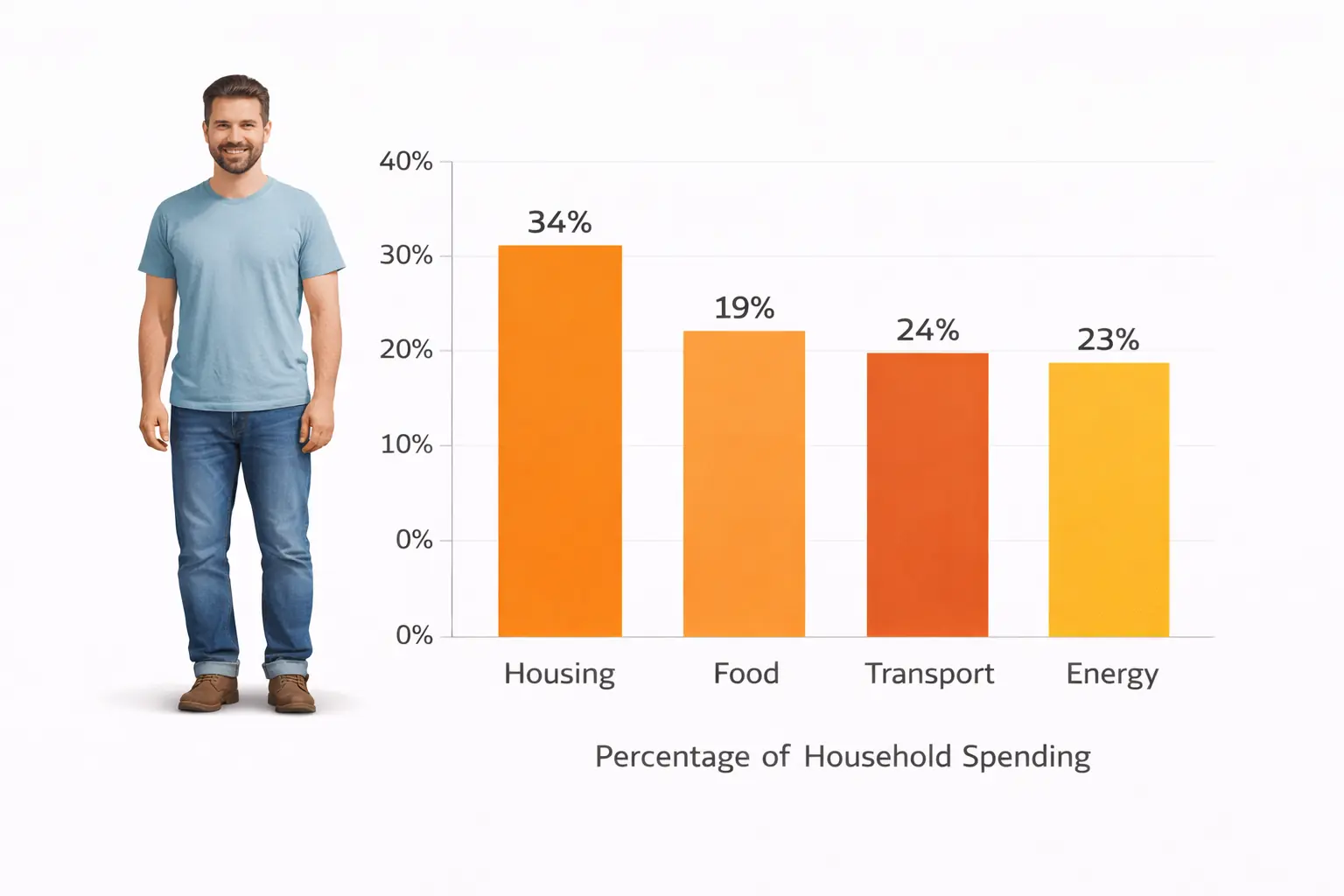
Breaking Down What You Actually Spend
Before you can calculate your PIR, you need to know where your money goes. Most people guess wrong.
The Reality Check
Studies show people underestimate spending by 20-40%. That coffee habit? Those Amazon orders? The subscriptions you forgot about?
Tracking reveals the truth.
How to Track Spending
Option 1: Bank statement review Download three months of statements. Categorise every transaction. Add them up.
Option 2: Budgeting app Apps like Money Dashboard, Emma, or your bank's app categorise spending automatically.
Option 3: Manual tracking For two weeks, write down everything. Everything. It's tedious but eye-opening.
The Categories That Surprise People
Subscriptions. Netflix, Spotify, gym, apps, delivery passes. These add up fast. The average UK household has 6-8 subscriptions totalling £50-100/month.
Food waste. About 30% of food bought gets thrown away. That's 30% of your grocery budget in the bin.
Transport. If you own a car, the total cost (payments, insurance, fuel, maintenance, parking) is often £400-600/month. Many people only count fuel.
"Little" purchases. Coffee, snacks, impulse buys. £5 here, £10 there. Easily £100-200/month.
Use the Budget Calculator to build a complete picture of where your money goes.
How to Calculate Your Real Purchasing Power
Purchasing power tells you what your money can actually buy. When costs rise faster than your income, purchasing power drops.
The Formula
Real Purchasing Power = 100 / (1 + Your PIR)
If your PIR is 7%, then:
- Purchasing Power = 100 / 1.07 = 93.5
Your money is worth 6.5% less than it was last year. You can buy 6.5% less stuff with the same income.
What This Means Practically
If you earned £40,000 last year and £40,000 this year, you actually have LESS money in real terms.
To stay even, you'd need a 7% raise — £42,800.
Most people didn't get 7% raises. That's why so many feel squeezed even when headlines say inflation is "falling."
The Wage Gap Problem
Here's a simple way to see if you're falling behind:
Your raise % − Your PIR = Real change
- Got a 3% raise with 7% PIR? You're down 4% in real terms.
- Got a 5% raise with 5% PIR? You're breaking even.
- Got an 8% raise with 6% PIR? You're actually ahead.
Use the Salary Calculator to see your take-home pay after taxes, then compare to your actual costs.
What's Changing in 2026
Let's look at what's driving costs this year and what experts expect.
Housing
Rent continues to rise in most cities. Limited supply and strong demand keep pressure on.
Expected 2026 changes:
- Rent in major cities: +5-8%
- Mortgage rates: Stable to slight decrease
- Council tax: +4-6% in most areas
If you're renting, this is probably your biggest cost increase.
Energy
Energy markets have stabilised compared to 2022-2023, but prices remain high by historical standards.
Expected 2026 changes:
- Gas and electricity: -2% to +5% depending on supplier and tariff
- Price cap adjustments in April and October
Switching suppliers and fixing rates can make a big difference.
Food
Food prices rose sharply in 2023-2024. The pace has slowed but hasn't reversed.
Expected 2026 changes:
- Groceries: +3-6%
- Eating out: +5-8%
Shopping smarter (own brands, meal planning, reduced waste) has real impact here.
Transport
Fuel prices fluctuate with oil markets. Insurance continues to climb.
Expected 2026 changes:
- Petrol/diesel: Unpredictable, budget for +5-10%
- Car insurance: +8-12%
- Public transport: +4-6%
If you can reduce driving or switch to public transport, the savings are significant.
Childcare
Childcare remains one of the fastest-rising costs for families.
Expected 2026 changes:
- Nursery fees: +5-8%
- After-school care: +4-7%
Government support is expanding, but costs still outpace help for many families.

Practical Ways to Fight Rising Costs
You can't control inflation. But you can control your response to it.
Big Wins (£100+ monthly savings)
1. Housing
- Negotiate rent at renewal (many landlords prefer keeping good tenants)
- Consider moving to a cheaper area
- Take in a lodger if you have space
2. Energy
- Switch to a better tariff (use comparison sites)
- Fix your rate if prices are expected to rise
- Invest in insulation and draught-proofing
- Smart thermostats save 10-15%
3. Transport
- Work from home more if possible
- Use public transport for commutes
- Shop around for insurance every year
- Consider a more efficient car
4. Food
- Plan meals and shop with a list
- Use own-brand products (30-50% cheaper, often same quality)
- Reduce food waste (plan portions, use leftovers)
- Cut back on takeaways and eating out
Medium Wins (£20-100 monthly savings)
5. Subscriptions
- Audit every subscription
- Cancel ones you don't use weekly
- Share family plans where allowed
- Look for free alternatives
6. Insurance
- Shop around every renewal
- Increase excess to lower premiums
- Bundle policies for discounts
7. Phone and broadband
- Negotiate at contract end
- Switch providers for new customer deals
- Consider SIM-only mobile plans
Small Wins (Add Up Over Time)
8. Daily habits
- Make coffee at home
- Pack lunches
- Use cashback apps
- Buy second-hand where sensible
Use the ROI Calculator to compare the value of bigger changes. Is moving worth the hassle? Is a new car worth the cost savings?
Planning for the Rest of the Year
Here's a practical approach to managing your money through 2026.
Step 1: Know Your Numbers
Calculate your:
- Total monthly spending (use Budget Calculator)
- Personal Inflation Rate (formula above)
- Real purchasing power change
You can't manage what you don't measure.
Step 2: Build a Buffer
With costs uncertain, a larger emergency fund helps. Aim for 3-6 months of expenses.
If that seems impossible, start with £500. Then £1,000. Something is better than nothing.
Step 3: Plan for Known Increases
You know some costs are coming:
- Council tax rises in April
- Insurance renewals
- Energy price cap changes
Plan ahead so these don't surprise you.
Step 4: Review Monthly
Spend 15 minutes each month reviewing:
- Did I spend more or less than expected?
- What cost changes are coming?
- Am I on track for my goals?
Small adjustments monthly prevent big problems later.
Step 5: Increase Income If Possible
Cutting costs has limits. At some point, you need more money coming in.
Options to consider:
- Ask for a raise (prepare your case with data)
- Look for a better-paying job
- Start a side hustle
- Sell things you don't need
- Rent out a room or parking space
Common Questions
How do I find inflation rates for specific categories?
The Office for National Statistics (ONS) publishes detailed breakdowns. Search "ONS CPI detailed breakdown" for category-specific rates.
Is my landlord allowed to raise rent by any amount?
In England, during a fixed-term tenancy, rent can only increase if there's a rent review clause. After that, landlords can propose increases but must follow proper procedures. Scotland has rent caps in some areas.
Should I fix my energy tariff?
It depends on predictions. If rates are expected to rise, fixing locks in current prices. If rates might fall, variable could be better. Nobody knows for sure. Consider your risk tolerance.
How accurate is my Personal Inflation Rate calculation?
It's an estimate based on average category inflation. Your actual rate depends on your specific suppliers, choices, and location. But it's much more accurate than using the headline CPI number.
What if my costs are rising faster than I can cut?
Focus on the biggest categories first (housing, transport, food). Consider whether increasing income is possible. Seek help from organisations like Citizens Advice if you're struggling with debt or bills.
How do interest rates affect cost of living?
Higher interest rates mean higher mortgage payments (if not fixed) and higher borrowing costs. But they can also slow inflation over time. If you have savings, higher rates mean better returns.
The Bottom Line
The official inflation rate is just a starting point. Your personal inflation rate is what actually matters.
In 2026, many people are experiencing 6-9% personal inflation even when headlines say 3-4%. That gap explains why people feel squeezed.
The solution isn't panic. It's clarity.
- Know exactly where your money goes
- Calculate your personal inflation rate
- Focus on the biggest cost categories
- Make changes that actually move the needle
- Review regularly and adjust
Use the Budget Calculator to start. Build from there. The numbers might not be fun to look at, but knowing them puts you in control.
Related Tools
- Budget Calculator — Track income and expenses
- Salary Calculator — Understand take-home pay
- Loan Calculator — Plan debt payments
- ROI Calculator — Evaluate big decisions
- Currency Converter — For international costs
- Percentage Calculator — Quick percentage maths